Let the AI see the robots: shipping research software with coding agents

SED seminar · Inria Paris · 8 Dec 2026

Geovane Fedrecheski, Lead Research Engineer, AIO team, Inria Paris

One engineer, one testbed, May to October 2026

A field report, not a product pitch.

  • The DotBots swarm-robotics testbed
  • Claude Code as the coding agent
  • What an agent needs before you trust it with code that ends in robots on a floor
Part 1: the problem

The DotBots testbed

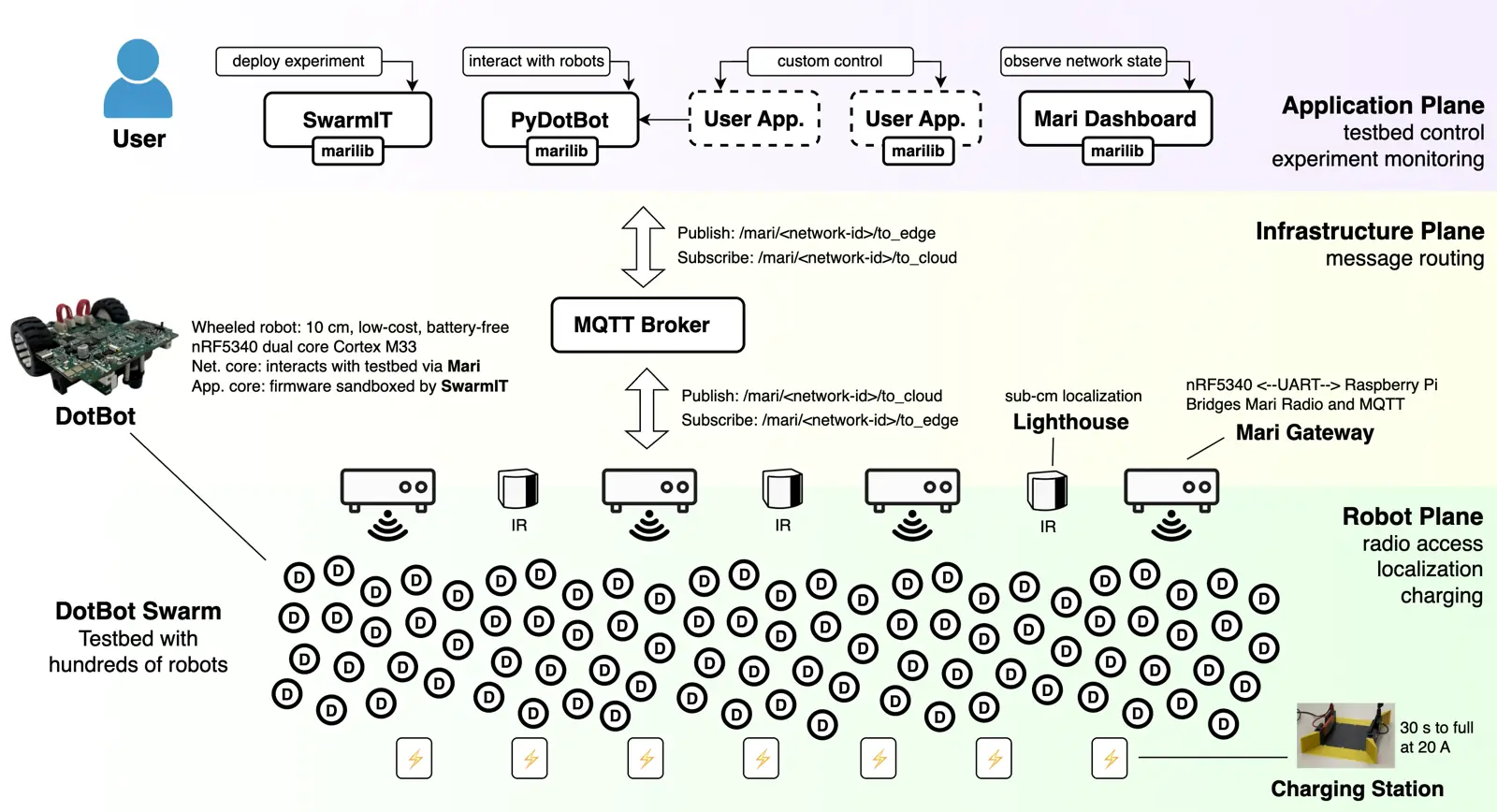
Up to 1,000 robots · six layers · C, Python, TypeScript · radio · real floors

One engineer, eleven repositories, a June deadline

  • May 2026: 11 repositories in the workspace
  • From May, effectively alone: other active authors 2.3 → 0.6 per month
  • A conference with a live demo a month away: ANTS 2026, Darmstadt, 8–11 June
  • Decision: try agentic coding on DotBots, as an experiment

PyDotBot · DotBot-firmware · DotBot-libs · mari · marilib · swarmit · dotbot-lh2-calibration · dotbot-provision · PyDotBot-utils · qrkey · dotbot-swarmit

Your version: is this you?

Your version

  • One person, many repositories, a deadline, nobody to review
  • Code that ends somewhere tests cannot see: robots an instrument, a cluster, a dataset, a user

Part 2: build the context layer

Day one: one folder with everything an engineer would read

workspace/
├── AGENTS.md
├── LOGS.md
├── repos/        11 repositories
├── papers/       as text
├── docs/
├── docs-hardware/
├── plans/
└── .claude/skills/
  • 5 May 2026: a workspace above all repositories
  • 7 papers, a project doc and 2 talk decks ingested as text
  • AGENTS.md at the root and in every repository
  • 13 May: the agentic setup lands upstream (PyDotBot#247)

Simplify first: fewer repos, one CLI, one config

$ dotbot --help
  fw       firmware: fetch, cache, flash
  device   one robot or gateway
  swarm    the whole swarm
  run      run an experiment

369 commits, 12 May to 4 June

~52 pull requests

~535 Python tests

6 repositories, 3 languages

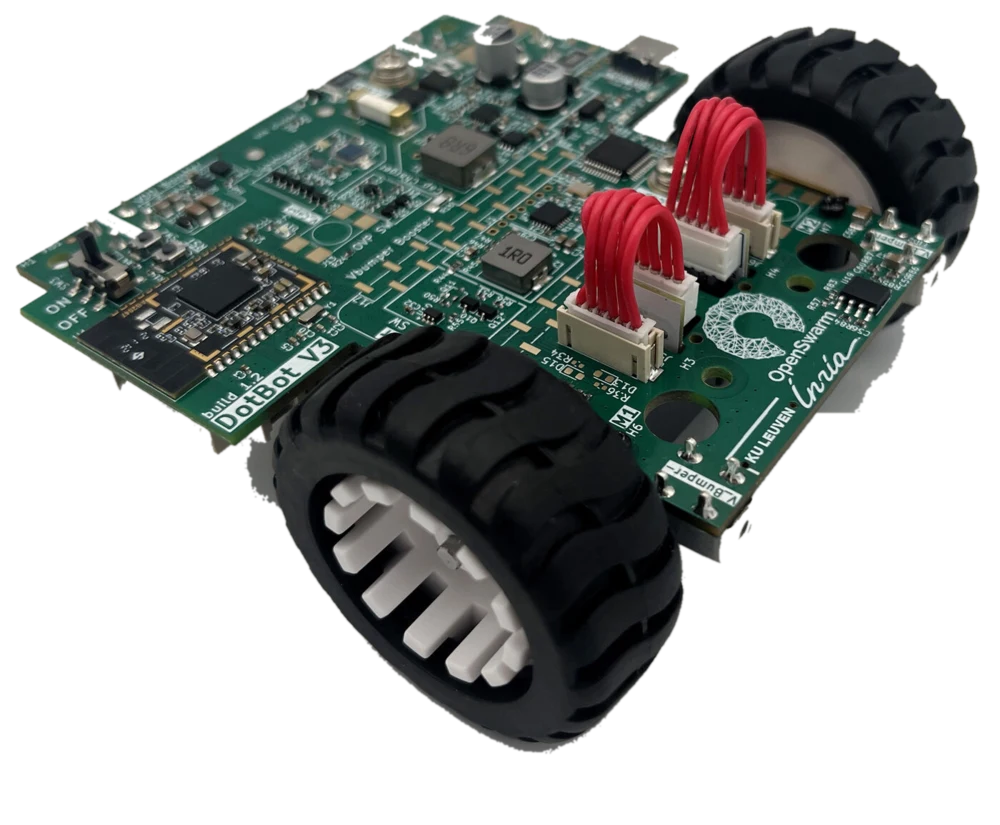
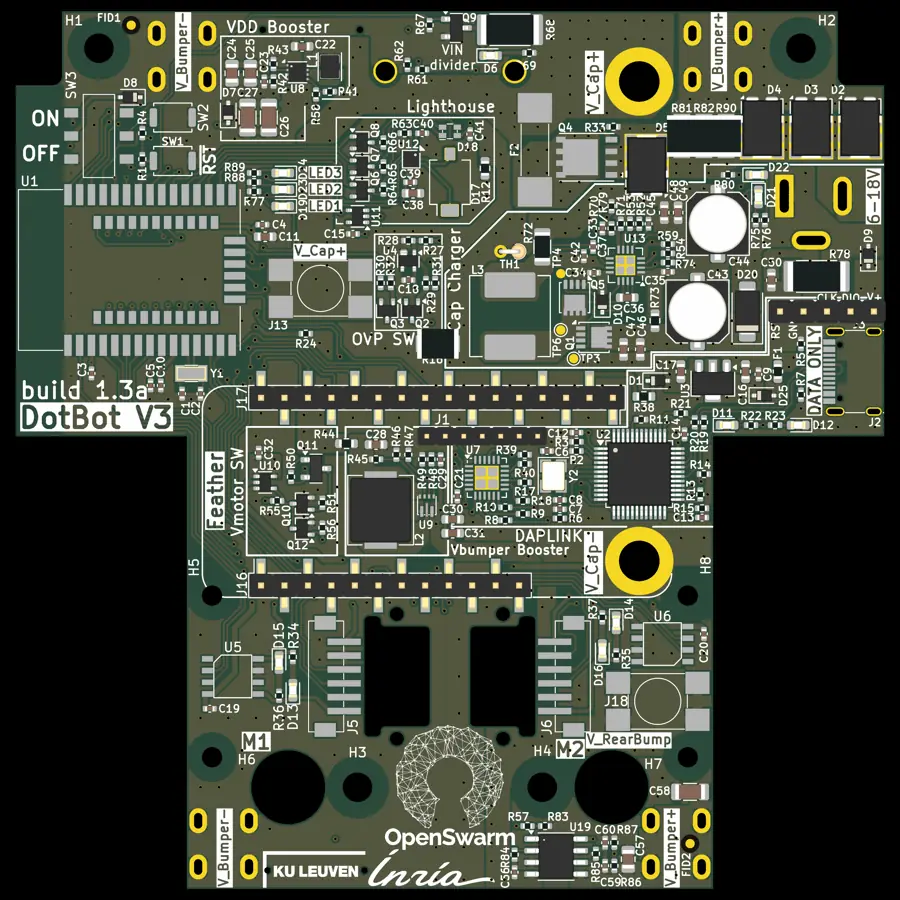
The context layer: papers and hardware as text
| GPIO  | Net               | To     |
|-------|-------------------|--------|
| P0.09 | LH2_E             | U12.C2 |
| P0.10 | /mcu/m2-ctrl.in-a | U6.2   |
| P0.11 | /mcu/m2-ctrl.in-b | U6.3   |
| P0.13 | LH2_D             | U12.C1 |
| P0.30 | /mcu/m1-ctrl.in-a | U5.2   |
  • Papers as greppable text
  • KiCad schematic → BOM (239 parts), GPIO map, sheet index
  • Datasheet (57k lines) and SVDs extracted

The hardware index catches real bugs

  • 22 May: firmware checked against the schematic, every pin
  • Encoder constant off by 2.33x: 12 counts per motor turn instead of 28
  • Gearbox about 51:1, not the nominal 50:1
  • Distance under-read by 9.1%, rotation by 14.4%, until caliper and Lighthouse measurements corrected wheel and track

Skills: the checklist you would give a new colleague

commit · pr · mari-firmware-review · best-in-class-survey · dotbot-firmware-build-flash · dotbot-swarm-ops · cli-naming · plan-html · dotbot-hil-validate · svg-diagrams · dotbot-code-review · hardware-debugging · …

  • Grown one at a time from May, about 16 today
  • Each one is a gate at a known moment: commit, pull request, flash, claiming “validated”
  • 90% of my commits since May say so: an AI-assisted: trailer (1,711 of 1,902)

Best-in-class survey: copy the best, not the average

Survey Principle Our design
npm, Docker, git one verb tree, discoverable help the dotbot CLI
Bitcraze cflib SyncCrazyflie a synchronous facade over an async radio the swarm SDK
14 robot platforms where the control loop lives the onboard control loop

Plans as files, with a validation ladder

  • HTML plans, each with an append-only, timestamped log
  • validated: none · ci · tests · hil, kept separate from status
  • The plan is the memory shared by sessions, agents and the human; the issue tracker is only a projection of it
  • July: UX research on interfaces for robotics systems, which fed the console design

[Visual to add: the live-state block of the control-loop plan]

Your version: what is your context layer?

Your version

  • What would a new colleague read before touching your code? Put it in the repository, as text: the paper, the instrument manual, the data schema, the cluster quirks
  • The checklists you repeat (release, review, “is it really validated?”): write them as skills
  • Simplify before you scale: every extra repository or script is one more place to guess

Part 3: let the AI see the robots

The gap: tests pass, the robot still does the wrong thing

  • CI and mocks check the code against itself; robots check it against physics
  • Rule: tests that only pass against a mocked radio, broker or serial port do not count as hardware validation
  • Since 10 August: an agent may set validated: hil only for a run it performed and logged (before: never)

none ci tests hil

The bench the agent drives

  • Laptop, Mari gateway, robots on a 1 x 1 m carpet, a Lighthouse base station, an overhead camera
  • The agent builds, flashes, runs bench scripts, reads telemetry
  • The human places and picks up robots
  • dotbot-hil-validate: a fixed check sequence, plus the signatures that look like failures but are not

[Visual to add: the bench from above: robots, markers, lighthouse, camera rig]

Telemetry 1: crash reports an agent can read

  • 29 May, before any bench: a crash-source sweep, 86 agents, 73 candidates, 44 refuted by adversarial verification, 29 kept and fixed (DotBot-firmware#411)
  • June: on a HardFault or SecureFault the bootloader latches CFSR, SFSR, PC and LR in RAM that survives the reset (swarmit#151)
  • 10 August, plan to merge in one day: the PC on a watchdog timeout too, in the ~61 µs before reset (swarmit#156)

crashed (watchdog0 HardFault pc=0x0000918e)

From a program counter to a root cause in 11 minutes

10:16 A robot reports pc=0x0000918e, CFSR UNALIGNED, only with two lighthouses on

10:19 The RTT logger cannot find its buffer in secure RAM: the agent writes a background reader, no halt

10:27 Reproduced on the bench: restart one station, crash within 2 s

10:28 Release ELF disassembled: vfprintf NaN branch → strlen → unaligned load

Root cause: an uncalibrated second station solves to NaN, and printing a NaN faults on the secure side. Fixed with a written regression check (swarmit#176).

Telemetry 2: a ceiling camera as an independent witness

  • Without a witness, an automated build, flash, measure loop optimizes the robot’s self-report, not its behaviour
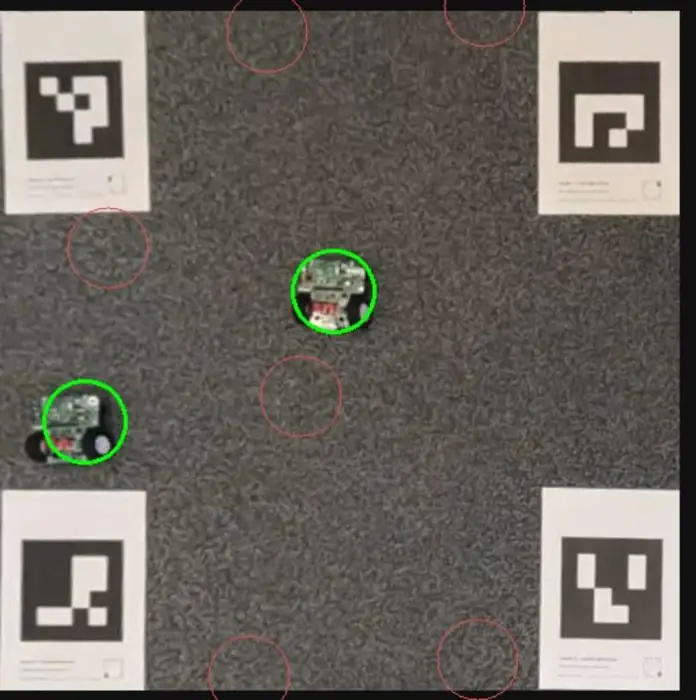
  • Four marker sheets in an area’s corners: the tool finds the camera that sees them and registers it to the Lighthouse frame (PyDotBot#293)
  • The console draws the image under the robots; bench agents record every run
Telemetry 3: robot detection without markers
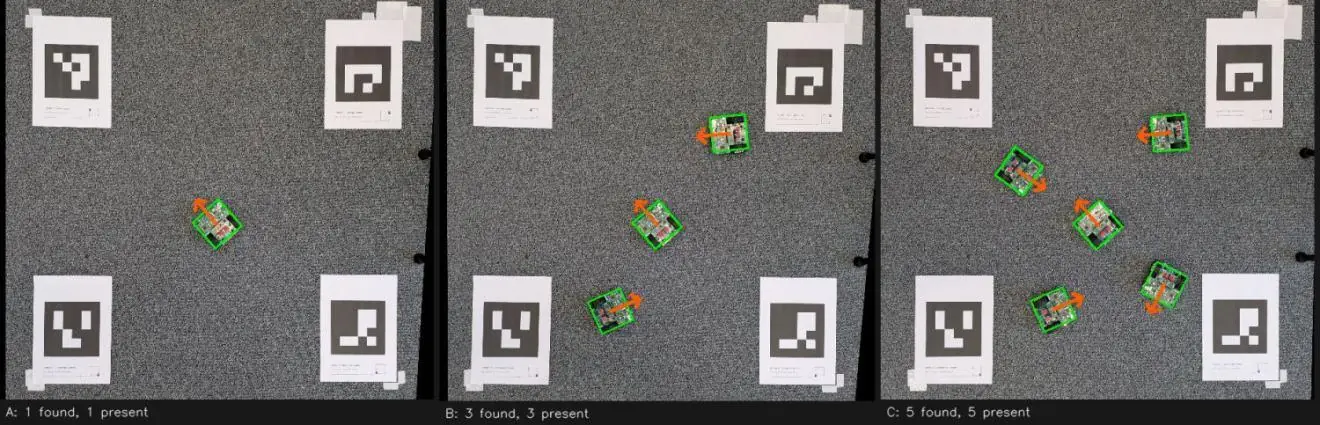
  • OpenCV only: no marker, no trained model. Position and heading beside the Lighthouse answer (PyDotBot#300)
  • Finding: the advertised position only updates past 50 mm. Many “localization failures” were quantization

The agent is wrong too, and the record shows it

09-04 17:47  wheel loop "pass"     wheels off the floor
09-04 17:59  corrected             re-run on the carpet
09-22        "right wheel 35%      it was the USB tether
              weaker"              and the charger cable
             mixer sign error      caught in the plan,
                                   before any code
  • Wrong claims are corrected in the log and in git, not silently

Your version: what is your ceiling camera?

Your version

DotBots Your system
the robots production logs, a test cluster, a data pipeline, an instrument
a crash PC a stack trace with symbols, a job ID, a failing row
the ceiling camera an independent witness: a reference dataset, a second measurement
validated: hil “validated” only for a run the agent did and logged

Part 4: what it enabled

Result: the control loop rebuilt and measured on robots
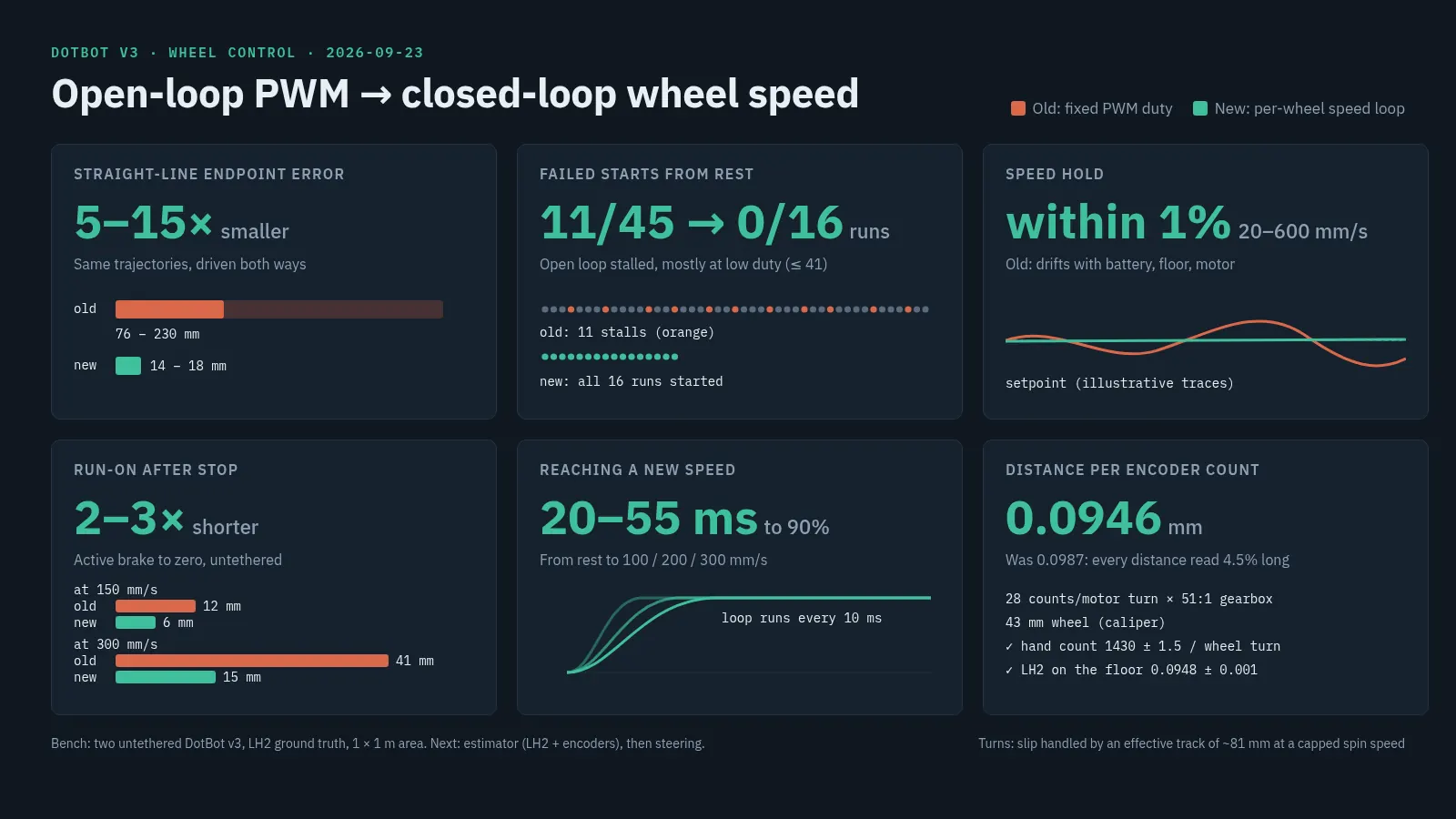
Shipped on top: Console, multi-Lighthouse, a workshop

  • DotBot Console, the new web UI (PyDotBot#279), the only one since September; scaled to 1,000 simulated robots
  • Multi-Lighthouse, after the control loop: several base stations, one calibration from spinning robots; October to November, released 9 November
  • DotBot Academy: hands-on workshops in São Paulo, October 2026, prepared with the same agents

[Visual to add: the console with 102 robots live, or the workshop room]

The numbers, May to October 2026

2.1x to 4.5x merged PRs per week, on the same active days (2.85 → 3.08)

389 → 2,757 automated tests, April to October

~9x faster over-the-air flashing, 210 s → 24 s

  • Releases ~1.9 → ~5.3 per month across 7 repositories
  • DotBot-libs: 0 → 126 host C tests, gating releases

Caveats: the team shrank to one, September was a burst, the mix shifted toward Python and TypeScript, human review of pull requests went from 8% to 0%.

Your version: what it buys, what it costs

Your version

Buys

  • Volume, and a higher test bar
  • If the verification is built first

Costs

  • The context layer is real work
  • Someone must still review
  • Vision, control, UI: still need an expert eye
  • Missing here: a second human reviewer

Part 5: responsible use

Responsible use at Inria, and beyond one repository

  • Inria guidance on AI tools: public and limited-distribution (DL) data are fine; confidential and restricted data stay out, or are redacted
  • DotBots code is public; AI help declared in every commit; vendor PDFs never committed, text extracts only
  • Beyond one repository: the same pattern runs as an always-on agent with notes as files, skills, scheduled routines and self-hosted apps

Takeaways

Context beats prompts. Your repository, papers and hardware as text are the prompt.

Verification is the bottleneck. Give the agent eyes (a crash PC, telemetry, a camera) and a rule about what it may claim.

Still a human job. Design calls, handling robots, “not good enough yet”.

Questions? · github.com/DotBots · pydotbot.readthedocs.io